

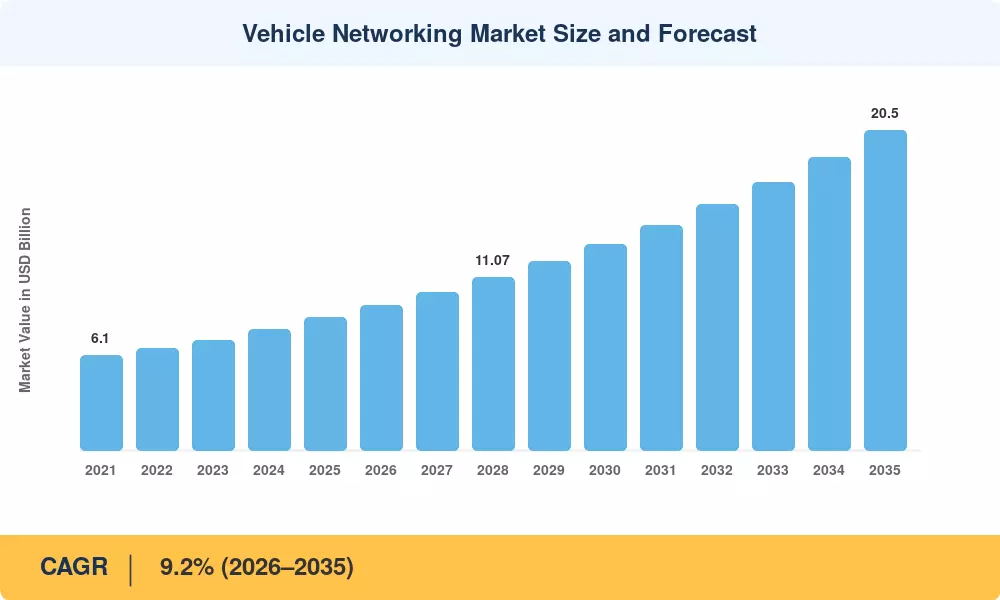
Vehicle Networking Market to Reach USD 20.50 Billion by 2035 at 9.2% CAGR
Vehicle Networking Market
The global Vehicle Networking Market was valued at USD 8.50 billion in 2025 and is projected to grow from USD 9.28 billion in 2026
The global Vehicle Networking Market was valued at USD 8.50 billion in 2025 and is projected to grow from USD 9.28 billion in 2026 to USD 20.50 billion by 2035.”
NEW YORK, NY, UNITED STATES, July 21, 2026 /EINPresswire.com/ -- Vehicle networking refers to the in-vehicle communication infrastructure enabling the exchange of information between and within electronic control units, sensors, actuators, and external systems such as infrastructure, cloud, and other vehicles. This ecosystem integrates both wired protocols and wireless technology, providing the backbone for everything from engine management to autonomous driving. The global Vehicle Networking Market covers the hardware, software, and services involved in connecting various electronic components of a vehicle, including powertrain, chassis, body electronics, safety systems, and infotainment systems, enabling them to communicate and share data with each other and with external networks.— Arti Dhapte
The market's robust growth is driven by several powerful catalysts. The UNECE WP.29 mandate requiring over-the-air update cybersecurity compliance for all new vehicle types sold after July 2024, and the European Commission's Euro 7 emissions framework, which demands real-time sensor fusion across multiple in-vehicle networks, are compelling automakers to replace aging distributed wiring architectures with higher-bandwidth, software-defined networking platforms. Together, these regulatory forces are driving transformation, with the market at the intersection of regulatory compliance and technological innovation.
Industry trends indicate a decisive shift from hardware-centric wiring harness sales toward software-middleware and service-layer revenue models. A technology inflection point is reshaping the Vehicle Networking Market at its core. Legacy controller area network buses running at 500 kbit/s are giving way to multi-gigabit Ethernet backbones capable of supporting Level 3+ autonomous driving stacks. BMW alone committed EUR 1.2 billion in 2024 toward centralized compute and zonal networking upgrades across its Neue Klasse platform. General Motors and Hyundai have disclosed comparable programs, each exceeding USD 800 million in cumulative R&D through 2027.
Technological developments are rapidly expanding the market's capabilities. Automotive Ethernet is the standout growth story, with the OPEN Alliance SIG's standardization of 100BASE-T1 and 1000BASE-T1 physical layers reducing per-port costs. Surround-view camera systems, lidar point clouds, and in-cabin monitoring systems all demand the multi-gigabit throughput that only Ethernet can deliver. The shift from domain-based to zone-based E/E architecture produces a new product category: zone controllers that aggregate sensor, actuator, and power-distribution operations inside a physical vehicle zone.
Policy and regulatory influence on the market is substantial and growing. The UNECE WP.29 regulation (UN R155/R156) requires every new vehicle type to implement a certified cybersecurity management system and secure software update capability. Japan, South Korea, and the EU have already transposed these rules into domestic law, affecting an estimated 45 million new vehicle registrations annually. This single mandate forces OEMs to deploy gateway ECUs with hardware security modules and encrypted network segments, lifting per-vehicle networking content value by an estimated USD 35–55 per unit. The Vehicle Networking Market benefits directly as automakers replace flat CAN topologies with segmented, firewall-equipped architectures.
The demand outlook remains exceptionally strong, with the market poised for sustained double-digit growth. North America commands the largest share at roughly 32% of 2025 revenue, driven by heavy investment from Detroit-based OEMs and Tier-1 suppliers in software-defined vehicle platforms. Asia-Pacific is the fastest-growing region with a forecast CAGR of 11.4%, fueled by China's NEV penetration and Japan's push toward cooperative intelligent transport systems. Europe holds the second-largest share at 28%, underpinned by stringent safety and emissions regulations.
📍 Get Free Sample Report for Detailed Market Insights:
https://www.marketresearchfuture.com/sample_request/28002
Market Segmentation
By Protocol Type
The vehicle networking market is segmented by protocol type into CAN/CAN FD, Automotive Ethernet, LIN, FlexRay, and MOST/LVDS. CAN/CAN FD retains the largest share at approximately 38% of 2025 revenue, sustained by its entrenched position in powertrain and chassis domains. The protocol's decades-long validation history, low transceiver cost (under USD 0.50 per node), and robust electromagnetic interference tolerance make it the default for powertrain and chassis networks. Automotive Ethernet is the fastest-growing protocol segment with a projected CAGR of 14.8%, driven by ADAS data throughput requirements exceeding 1 Gbit/s. As per-port costs drop to approximately USD 8–12, Ethernet becomes viable for mid-volume vehicles. LIN maintains steady demand at USD 0.72 billion in 2025, serving body electronics and low-speed actuator control. FlexRay holds 4% market share, serving brake-by-wire and steer-by-wire in premium vehicles.
By Application
Application segmentation covers ADAS & Autonomous Driving, Powertrain & Chassis, Infotainment & Connectivity, Body & Comfort Electronics, and V2X Communication. ADAS and autonomous driving applications represent the primary growth engine, expected to reach a CAGR of 12.1% through 2035, propelled by regulatory mandates for emergency braking, lane-keeping, and driver monitoring systems. Each additional ADAS sensor adds 1–3 networked nodes and increases backbone bandwidth requirements. Infotainment networking holds an estimated 22% share, reflecting rising consumer expectations for streaming and connectivity, with modern digital cockpits integrating 3–5 display screens. V2X communication represents the highest-growth application at a CAGR of 18.5%, driven by C-V2X and DSRC deployment.
By Vehicle Type
Vehicle type segmentation includes Passenger Cars, Light Commercial Vehicles, and Heavy Commercial Vehicles. Passenger cars dominate the market by volume at 74% share, driven by volume-driven demand across all protocols. Light commercial vehicles represent USD 1.15 billion in 2025, driven by fleet telematics and delivery route optimization. Heavy commercial vehicles represent the fastest-growing vehicle type segment at a CAGR of 10.6%, with autonomous trucking programs requiring networking architectures with redundancy levels comparable to aerospace systems, lifting per-vehicle networking content well above USD 1,500 in pilot deployments.
By Region
Regional segmentation includes North America, Europe, Asia Pacific, South America, and the Middle East and Africa. North America leads with 32% of global revenue in 2025, anchored by software-defined vehicle investments. Asia-Pacific is projected to reach USD 7.15 billion by 2035, overtaking Europe in absolute terms by 2031. Europe accounts for 28% of the global market, shaped by UNECE and Euro 7 compliance mandates.
🛒 You can buy this market report at:
https://www.marketresearchfuture.com/checkout?currency=one_user-USD&report_id=28002
Regional Analysis
North America
North America commands the largest share of the Vehicle Networking Market at roughly 32% of 2025 revenue, anchored by heavy OEM and Tier-1 R&D spending concentrated in Michigan, Silicon Valley, and Austin. The United States accounts for 78% of regional share, driven by GM's Ultifi platform and Ford's BlueOval Intelligence initiative, together representing over USD 4 billion in software-defined vehicle investment through 2028. Canada's vehicle networking demand is rising at an 8.9% CAGR as provincial EV mandates drive new platform introductions. Mexico contributes USD 0.18 billion in 2025, with its role as a nearshoring hub for wiring harness manufacturing supporting Tier-1 suppliers like Aptiv and Lear Corporation.
Europe
Europe holds the second-largest share at 28% of the global market, shaped by the UNECE WP.29 regulation and Euro 7 emissions framework. Germany leads regional demand at 36% of European share, driven by Volkswagen's SSP architecture and BMW's Neue Klasse, together consuming billions of euros in Ethernet switches, zone controllers, and high-speed connectors through 2030. France grows at a 9.5% CAGR, supported by Renault SDV and Stellantis STLA programs. The United Kingdom contributes USD 0.31 billion in 2025, benefiting from its semiconductor design cluster around ARM and Imagination Technologies. Eastern European assembly hubs contribute to the remaining 22% of regional share.
Asia-Pacific
Asia-Pacific is the fastest-growing region with a forecast CAGR of 11.4%, fueled by China's NEV penetration exceeding 10 million units in 2024 and aggressive C-V2X rollout targets under the Ministry of Industry and Information Technology. China accounts for 48% of regional share, with domestic OEMs like BYD, NIO, and XPeng vertically integrating networking hardware design in-house. Japan contributes USD 0.56 billion in 2025, with Toyota's Arene OS targeting 2026 deployment. South Korea grows at a 10.8% CAGR, driven by Hyundai's connected-car operating system (ccOS) and Samsung's automotive Ethernet chip production. India is the fastest-growing major market at a 12.3% CAGR, supported by its Production-Linked Incentive scheme and Tata/Mahindra EV networking investments.
Rest of the World
The Rest of the World segment, encompassing South America and the Middle East and Africa, presents developing market opportunities. Brazil anchors South American demand with 68% of regional share, supported by domestic production fleet modernization. The UAE accounts for 34% of Middle East and Africa regional share, driven by connected luxury imports and smart mobility projects. Saudi Arabia grows at an 8.5% CAGR, supported by NEOM and Vision 2030 automotive localization. South Africa contributes USD 0.13 billion in 2025, with gradual fleet renewal supporting demand.
Competitive Landscape / Key Players
The Vehicle Networking Market displays moderate-to-high concentration, with the top five players estimated to hold a combined 45–52% revenue share. Key companies operating in this market include NXP Semiconductors, Infineon Technologies, Robert Bosch, Continental AG, Texas Instruments, Marvell Technology, Broadcom Inc., Aptiv PLC, Microchip Technology, and Lear Corporation.
Strategic developments in the market include significant product launches and platform announcements. In April 2024, NXP Semiconductors launched the S32N55 vehicle super-integration processor, combining CAN FD, LIN, and multi-gigabit Ethernet interfaces on a single SoC, targeting 2027 production vehicle integration. In November 2024, Volkswagen Group confirmed that its Scalable Systems Platform (SSP) will deploy a full zone-based architecture with Ethernet TSN backbone across all brands starting in 2027. In September 2024, the OPEN Alliance SIG released the MultiGBASE-T1 specification enabling 2.5 and 5 Gbit/s Ethernet over single unshielded twisted pair, reducing wiring weight by up to 30% compared to traditional automotive cable.
Competitive differentiation increasingly hinges on semiconductor integration, AUTOSAR Adaptive middleware expertise, and established OEM supplier relationships. NXP maintains a broad protocol portfolio leadership position. Infineon focuses on powertrain and safety networking. Bosch provides full-stack system integration. Texas Instruments offers cost-optimized high-volume ICs. Marvell specializes in Ethernet switching solutions.
Latest Industry News & Developments
Recent industry developments highlight the ongoing transformation of the vehicle networking market toward higher bandwidth, greater integration, and software-defined architectures. In April 2024, NXP Semiconductors launched the S32N55 vehicle super-integration processor, combining CAN FD, LIN, and multi-gigabit Ethernet interfaces on a single SoC, targeting 2027 production vehicle integration. This development reflects the industry's move toward centralized compute architectures that consolidate multiple functions.
In November 2024, Volkswagen Group confirmed that its Scalable Systems Platform (SSP) will deploy a full zone-based architecture with Ethernet TSN backbone across all brands starting in 2027. This multi-billion-euro commitment represents one of the most significant platform transitions in the automotive industry, accelerating the replacement of legacy CAN-based architectures.
In September 2024, the OPEN Alliance SIG released the MultiGBASE-T1 specification enabling 2.5 and 5 Gbit/s Ethernet over single unshielded twisted pair, reducing wiring weight by up to 30% compared to traditional automotive cable. This technical standard enables higher bandwidth while reducing vehicle weight, supporting both ADAS requirements and fuel efficiency goals.
Market Challenges & Opportunities
Key restraints facing the vehicle networking market include legacy protocol lock-in and backward compatibility costs, with automakers spending decades validating CAN and LIN stacks. The shift to Ethernet-based topologies necessitates re-qualification of EMC shielding, connection waterproofing, and fault-tolerance mechanisms, a process projected to cost USD 15–25 million per vehicle platform. Semiconductor supply concentration, with NXP, Infineon, and Texas Instruments holding more than 65% of the automotive networking transceiver market, creates single points of failure risk. Cybersecurity compliance cost burdens on Tier-2 suppliers, with certification and audit expenses estimated at EUR 2–5 million per product family, may force consolidation. A skilled workforce shortage in automotive Ethernet design and price sensitivity in economy vehicle segments further constrain growth.
Emerging opportunities in the market are substantial and diverse. Ethernet-native zone controllers as a platform play present an incremental opportunity of USD 2.5–3.8 billion by 2032 as OEMs transition from domain-based to zone-based architectures. Vehicle-to-everything (V2X) communication monetization presents significant potential, with OEMs incorporating V2X-enabled networking modules to unlock recurring revenue streams from traffic data subscriptions, insurance telematics, and smart-city integration agreements. Emerging market growth in India and Southeast Asia, with India's PLI scheme allocating INR 25,938 crore (USD 3.1 billion) to boost domestic manufacturing, represents a high-growth revenue stream previously dominated by basic LIN installations.
Future potential lies in over-the-air software update revenue models, enabling automakers to sell feature upgrades post-purchase. Tesla generated an estimated USD 1.8 billion in software revenue during 2024 alone, and as more OEMs adopt OTA-ready infrastructure, the Vehicle Networking Market benefits from increased per-vehicle networking content designed to support continuous software delivery. Commercial vehicle fleet digitization, with fleet operators investing in real-time diagnostics and remote vehicle management, signals market expansion beyond passenger vehicles. Autonomous driving and redundant network architectures, requiring fail-operational networking with dual-channel Ethernet backbones, will see per-vehicle networking content exceeding USD 1,200 in high-value segments.
To explore more market insights, visit us at:
https://www.marketresearchfuture.com/reports/vehicle-networking-market-28002
Final Market Summary
The vehicle networking market is positioned for robust growth through 2035, driven by regulatory mandates for cybersecurity and OTA updates, ADAS data throughput requirements, and the accelerating migration to software-defined vehicle architectures. The projected valuation of USD 20.50 billion reflects rapidly expanding adoption across passenger cars, commercial vehicles, and autonomous driving platforms, with the market transitioning from hardware-centric wiring harness sales toward software-middleware and service-layer revenue models.
The medium-term growth outlook remains strong, with the market registering a CAGR of 9.2% during the forecast period. North America will continue to maintain market leadership through heavy OEM investment in software-defined platforms, while Asia-Pacific emerges as the fastest-growing region driven by China's NEV penetration and India's PLI scheme. The ongoing development of automotive Ethernet, zone controllers, and V2X communication systems will continue to expand market possibilities and applications.
Long-term industry potential extends beyond the current forecast horizon. Software-defined vehicles and middleware standardization, with an estimated 60% of new vehicles shipping with AUTOSAR Adaptive stacks by 2030, will make networking protocol selection a software-configuration decision. Autonomous driving and redundant network architectures, with Level 3 and Level 4 vehicles requiring fail-operational networking, will create a high-value tail segment. Vehicle-to-cloud and edge computing integration will see vehicles function as mobile edge-compute nodes, requiring onboard networking architectures capable of handling both safety-critical real-time traffic and high-bandwidth best-effort data flows. Manufacturers that successfully develop innovative semiconductor solutions, invest in software-defined networking platforms, and establish strong OEM relationships will capture substantial value in this evolving market. The transformation of vehicle networking from simple data buses to intelligent, software-defined communication infrastructure represents a fundamental shift in automotive architecture, enabling the connected, autonomous, and electrified vehicles of tomorrow.
More Related Reports from MRFR Library:
India Electric Car Market: https://www.marketresearchfuture.com/reports/india-electric-car-market-12684
Us Automotive Secondary Wiring Harness Market: https://www.marketresearchfuture.com/reports/us-automotive-secondary-wiring-harness-market-13143
Us Automotive Diagnostic Tool Market: https://www.marketresearchfuture.com/reports/us-automotive-diagnostic-tool-market-13256
Gondola Market: https://www.marketresearchfuture.com/reports/gondola-market-14044
Us Electric Vehicles Battery Market: https://www.marketresearchfuture.com/reports/us-electric-vehicles-battery-market-14099
Us Automotive Electric Motors Market: https://www.marketresearchfuture.com/reports/us-automotive-electric-motors-market-14514
Us Automotive Intercooler Market: https://www.marketresearchfuture.com/reports/us-automotive-intercooler-market-14842
Us Automotive Robotics Market: https://www.marketresearchfuture.com/reports/us-automotive-robotics-market-15936
Mobile Food Truck Market: https://www.marketresearchfuture.com/reports/mobile-food-truck-market-16077
Tourist Bus Market: https://www.marketresearchfuture.com/reports/tourist-bus-market-16138
Larry Wilson
WantStats Research And Media Pvt. Ltd.
+ +1 855-661-4441
email us here
Visit us on social media:
LinkedIn
Facebook
YouTube
X
Legal Disclaimer:
EIN Presswire provides this news content "as is" without warranty of any kind. We do not accept any responsibility or liability for the accuracy, content, images, videos, licenses, completeness, legality, or reliability of the information contained in this article. If you have any complaints or copyright issues related to this article, kindly contact the author above.
